
My own small contribution to Slade's rise and rise is indelibly linked in my memory with my first and only encounter with the late actor John Wayne. He too had his own curious rock and roll connection because Buddy Holly went to see his cowboy movie 'The Sons of Katie Elder' at Lubbock Odeon in Texas and picked up on the catch phrase Wayne used continuously throughout the film, "That'll be the day." which became Buddy's first hit with The Crickets.
When Hyde Park was just a flower pot in the Summer of '69, I was operating my first press agency called Jigsaw (we had a number of puzzling clients) out of a garret in London EC4, next door to the famous gentleman's club, The Garrick, and representing the varied talents of The Who, The Beach Boys, The Moody Blues, Marc Bolan and Manfred Mann, amongst others.
In my days as a journalist on the NME I had become a close friend of The Animals bass player, Chas Chandler, who was now bending my ear about his latest discoveries from the unlikely back alleys of Wolverhampton. He sent me tapes they had made as The 'N Betweens and later Ambrose Slade in order to persuade me to take them as clients.
"Yoos have just got to see them live." insisted my late loveable and obdurate Geordie mate. "Live is what they are all aboot. I am going to set up a rehearsal just over the road from your office and I want yoos to come and see them."
Chas was not an easy man to refuse. In the back of my mind was the fact that he had turned up an unknown guitarist called Hendrix playing at The Cafe Wha' in New York a few years previously and managed him to super stardom. He knew talent when he heard it, so I half heartedly agreed the meet.
I was late leaving my London office that afternoon in June and bounded down the steps in my cool new shades onto the hot pavement outside and cannoned off the back of a huge man carrying a Stetson hat.
"So sorry." I said lamely. "I didn't see you."
"That's all right boy." drawled the giant turning and looking down on me with the hideous lopsided leer I had seen many times in the cinema and an equally hideous grey toupee, "I didn't see you either." I had just been "pigmytised" aged 28 by the great John Wayne who was shooting a detective movie called 'McQ' in The Garrick Club next door and had stepped outside for a cigarette and a breather.
"Guess who I've just bumped into." I asked Chas breathlessly, apologising for my late arrival in the basement club a few minutes later. "These lads are going to be bigger than boogering John Wayne." he roared instantly. "Bigger than Elvis and bigger than The Beatles." Chas never sold his boys short. As Noddy put it, "Once he was behind you he never left your shoulder."
I had arrived in the tea break and the Wolverhampton "all-sorts" were gathered around the tea lady, Nora, who poured a brew from a huge tea pot whilst a dew drop hung precariously from the end of her nose. I nervously awaited its descent into my cuppa but it hung on and Noddy was the first to notice my concern and ventured to suggest that it was "extra with a bogie." This was my first brush with his bawdy seaside postcard humour.
Chas confiscated the tea mugs and pushed his boys onto the small stage at the back of the club. "Wait till yoos hear this lot," he said proudly. "Yoos not heard anything like this band." He was right - nothing as bloody loud anyway. Not even The Who.
The manager stood proudly a few feet from the stage with his arms folded across his chest and a beatific smile across his face as though he was the goose who had just laid the golden egg, whilst the yellowing, disapproving features of old unamplified jazzers like George Melly, Kenny Ball, and Acker Bilk stared down upon these deafening young pretenders, from their black and white framed photos on the dingy walls of the club.
I retreated to the furthest wall of the basement and flattened myself against it, and though I wouldn't swear to it, I think the amps were turned up to 11. Just as my ears were recovering during a break the wretched bass player produced an electric violin that went down in my experience as the first string instrument to deafen me. Gradually my ears became adjusted to the volume and I began to realise that there were some major plus points.
The young Slade had the neat trick of starting some numbers beneath the pain threshold and then letting you have it force ten between the ears. They had both "yoof" and "whoomf" in their arsenal. The other most obvious asset seemed to be the lead singer with his gob-blaster of a voice, who sounded like a souped up John Lennon, plus the bass player/demon violinist who was playing some clever licks on his bass guitar as though it were a lead instrument. Most importantly the band was very together.
It was Nod who told me the tale of how Slade eventually honed themselves into a tight working unit, not only in the beat clubs of Hamburg but more crucially while doing some early forced labour in The Bahamas.
"For the first few years we were booked by a local agent in Wolverhampton called Maurice Jones, who became our first manager." They were considered a good enough group even then to compete with the better known bands like Cream, with whom he booked them out. Eventually Maurice came up with what he thought was an absolutely dream booking for them - a one month residency in The Bahamas.
None of the band had ever been anywhere that exotic and they were suddenly staying in a luxury hotel and told to order anything they wanted on room service and put it on the club owner's tab. The club proved to be little more than a shack in the middle of nowhere and they had to play several sets every night, of which the first was a selection of pop songs for tourists. But it got tougher.
"It was the later set we played to the locals after midnight that really scared us," recalls Nod. "Because we were four white kids in funny gear trying to please the local black gangs who were into calypso and ska. We decided to give them our James Brown soul selection and we could not have made a better choice because unbeknown to us Brown was considered a god in The Bahamas and four white kids playing soul music was some novelty.
"We also had to become versatile and adapt to provide backing for local entertainers like limbo dancers, fire-eaters and transvestite go-go dancers. One of the big attractions was called Silver Man. He sprayed himself all over in paint and did a wild Voodoo dance, which had to be completed quickly or he passed out from skin dehydration."
The compere was a gay bongo player called Eric who used to give Nod a drink out of his special rum bottle each night, which he had secretly soaked with marijuana. Nod couldn't understand why it had such an effect on him for some days. Eric overran on his bongo solo one evening while Silver Man sweated in the wings until he eventually collapsed and passed out. Nod managed to revive him by washing his paint off, but it was like that each time they played. "We were rocking our socks off with loonies every night," sums up Nod.
Half way through this Bahamas rock circus residency, disaster struck and the club owner disappeared with thousands of pounds, leaving them stranded with a massive hotel and bar bill unpaid. The hotel moved them into the equivalent of a broom cupboard and when the club re-opened under new management they took half of their wages until the outstanding amount was paid off. Slade had to slog it out for three months, working like musical slaves until they were able to leave the island.
Nod took charge again and sorted out their financial difficulties. He was always the one who had to budget their money when they needed a new tyre on the van or replacement equipment.
"We made friends in the Bahamas with a lot of local kids who were from American families," he recalls. "And they brought lots of records with them which had yet to be released in England, like Steppenwolf's 'Born to Be Wild,' which we worked into the stage act."
It was that crash course in survival in The Bahamas that pulled them together and forged the band's strong camaraderie. They came home a different a group and a lot closer. It was that close-knit spirit that sold me on Slade when I first saw them at Studio 51 in Great Newport Street that summer of 1969 with Chas.
As a press agent I was still a little suspicious of any group who could have once allowed themselves to be called The 'N Betweens or even worse, Ambrose Slade, but later Nod explained the misnomers.
"We were first introduced to The Fontana Records MD Jack Baverstock as The 'N Betweens and he disliked the name too," Nod told me. "He said it made us sound like transsexuals and then he went and lumbered us with Ambrose Slade because he had some daft secretary who called the things on her desk by nicknames. Her phone was 'Eric' and her typewriter was 'Sid' and she had two other items which I can't recall called 'Ambrose' and 'Slade.' Jack put them together and came up with Ambrose Slade."
Unbeknown to the band I had previously heard of The 'N Betweens as a journalist on the NME because I occasionally ran into an American hustler in the late Sixties called Kim Fowley, who looked like an ambulating stick insect and whose initial claim to fame was producing the instrumental hit single 'Nut Rocker' for B. Bumble and The Stingers. Much later he managed The Runaways
Fowley carried a briefcase full of bank notes, which he opened in the street to impress people, and loudly shouted things like "Outasite," "Super Cool" and "Groovy." He was an agreeable, eccentric blagger on the prowl in Swinging Sixties London looking for English talent to produce and manage.
"Kim Fowley turned up at a London club called Tiles in 1966, where we were playing as The 'N Betweens," recalls Jim. "He was tall as a telegraph pole and gaunt, with a big black hat, but was a really funny, eccentric guy."
"You guys gonna be huuuuuuuuuuuge;' he drawled to Jim, as he draped himself in the doorway to their dressing room. "You guys know how to PRO-JECT and you have a big sound. I am gonna make you stars because I produce hit records and I know how to grease and hype at the most profitable levels - and look, I got all my own teeth," and he smiled like a piano keyboard.
Fowley took the boys to "project" in London and recorded a cover version of The Young Rascal's hit 'You Better Run,' coincidentally also recorded by Robert Plant and his local group, Listen, at the same time. The record was number one locally but flopped nationally.
"We kept Tom Jones' 'Green Grass of Home' off the top of the charts for weeks in Wolverhampton though," recalls Don wryly.
Jim remembers The 'N Betweens as his first big chance at the big time in Wolverhampton, where they were considered a "group most likely." But his first impressions of Nod were mixed.
"When they told me that they were looking for someone for the 'N Betweens, I was knocked out because they had a real rep locally and were playing Rolling Stones rhythm and blues material, which I loved. What they didn't tell me was that they were in the stages of a split and the lead singer, who I rated, was leaving in addition to their bass player.
"The next thing I knew a van pulled up outside my home a few days later, where I was studying for my GCE's, with Don and Dave and this strangely older-looking cove in battered blue jeans apparently called 'Nob', who kept scratching his balls and looking at me suspiciously.
"I viewed him with equal suspicion as I knew he came from Steve Brett and The Mavericks, who were more cabaret than Rolling Stones. Anyway, I decided to go with 'Nob' and his mates as I had no other offers anyway. I called him Nob for three months before I found out he was Nod."
The band first rehearsed in a small pub called Three Men In A Boat in Wolverhampton to see if they would click, and right from the first Wilson Pickett number they struck up there was an obvious chemistry. They broke the news to the old guitarist that he was out - it was not an amicable split - and they quickly got on the road and began looking for a new identity. They wanted to be and sound different.
"It was Dave who gave us the reputation for a big sound," remembers Jim. "Everyone soon knew we were super-loud and people couldn't quite figure out how we did it. It started when Dave brought a treble booster for his Burns guitar. After I heard the volume, I had to get one and so did Nod."
Don's old school friend and their faithful tour manager, Graham Swinnerton, came up with the idea of linking their individual speakers so that each musician's output came through everyone else's speakers as well as his own. No longer was it all bass at one side of the stage and all guitars at the other. It became a source of amazement to other musicians as to how they got their big, well balanced sound before anyone had a mixing desk. They also now had double amps on top of massive Wem speakers, which were so tall the diminutive Dave had to climb on a chair to reach his amp.
"We were terrifyingly loud," says Jim. "No one slept or walked out on our act. We pinned audiences to the wall with what Chas' right hand man and ex-Animal drummer Johnny Steel used to call our 'G' force."
"It were loud tonight mon;' John Steel, another Geordie, would tell them after a gig. He had been frightened as an infant in Newcastle by an early English black and white movie called 'The Sound Barrier' in which the earth's gravitational pull impacted on the pilots face. "The G force was forcing back the skin on my face, and mind yoos I was at the back of the hall." John would tell them mockingly, stretching his cheeks with his fingers. John loved Slade and was a terrific support to them in the early days.
"We had this attitude that every time we went on stage we would make it an event;' says Jim. "When Nod joined he was playing lead guitar and I played a bass as if it was lead, then when Dave opened up we had a three strikers up front. We created a solid wave of sound in front of us and Don provided the wall behind us. We had that attitude which the kids took in those days that if it was too loud then you were too old."
It was as Ambrose Slade that the group recorded their first album for Philips Fontana. On 'Beginnings' they included a bit of everything, such as the Beatle's song 'Martha My Dear,' Steppenwolf's 'Born to be Wild' plus the Moody Blues composition 'Fly Me High.' If anything there was a bit too much variety and no identity of their own, although it clearly demonstrated their versatility.
Right from the start, as their PR, I plotted publicity ideas with Chas to go with their first single (as Slade), 'Wild Winds Are Blowing', which was a great favourite on stage but refused to chart. Gone was the time when he could buy a single into the top twenty like he admitted doing for Hendrix's first record 'Hey Joe.'
"Eeee it's not like the good old bad days," Chas said to me with exasperation after another flop single.
"Yoos cannae fix 'neebody these days - I do miss payola."
Most of the initial publicity I generated in the first year leaned heavily on the boys being Jimi Hendrix manager's latest discovery. Rock writers in the main seemed wary of them, despite their obvious talents, and the fact that they looked no different to a hundred other bands didn't help.
We had to find some way of drawing attention to the group so that people would be curious enough to discover for themselves how good they were. Sadly when their second single, 'The Shape Of Things To Come', also flopped despite an excellent production and some favourable reviews, Chas and I had a council of war in a pub behind his London office and after a few pints I came up with what felt like a brain wave.
"We have to ally them to something that is in the news now to generate publicity;' I said to Chas. "Something that is fashionable but dangerous and causing controversy. The answer could be ... The Skinheads. We could turn 'em into the first skinhead band, but you could never talk them into those shaved heads, boots and braces, could you?"
Chas's eyes lit up in much the same way as when I had once suggested Hendrix set fire to his guitar for the first time. "Brilliant;' he said "Yoos leave that to me, mon."
When I sobered up next morning I was having doubts and rang Chas directly on getting into my office.
"We can't do this to them," I pleaded. "They're nice guys, not nasty skinheads. We might alienate the press with this."
"Too late," said Chas jovially. "We've got the boots and braces and they're in the barbers now getting the hair shaved off for a photographer."
"Jesus!" I gulped.
Chas always had the courage of other people's convictions and I was now committed to representing the boot boys of rock and roll. Once on the move he was as unstoppable as a Centurion tank. When I eventually saw the new photos I wasn't quite convinced that Dave and Jim had gone far enough, but in those long haired hippy days even relatively short hair was controversial and the boots and braces certainly made them look different.
"It was Chas who really persuaded us to go through with it;' says Nod. "Dave was almost in tears when they cut his hair because he was so vain about it. At first he refused but then Chas said, 'Do yoos want to be a milliooonaire or noo, Devid?' Well that was all you had to say to Dave at any time.
"Don and I sort of liked the tough image because it gave us an edge at gigs;' adds Nod. "Jim and Dave hated it. From that point on we never had any trouble getting paid at venues though - people were nervous of us and we were not being ignored.
"Difficulties arose when The BBC banned 'The Shape OfThings To Come' because they thought we might be the real thing and inciting violence. Stanley Dorfmann, who directed Top of the Pops, first refused to have us on because his son had been beaten up by skinheads, but relented later;' says Nod. "In fact we were more often the victims of our own image than victors. The real skinheads never really accepted us because they liked ska and blue beat and we played rock with a violin, but the establishment were nervous about whether we were for real."
Finally, about 50 or so real skinheads turned up at Guildford Civic Hall to sort Slade out and it was only due to the fact that Noddy had taken to carrying an air rifle for protection, and waving it out the window of the van like Clint Eastwood, that they got away without a beating. However, unlike before, when they turned up at a gig or a TV show and no one took any notice of them, now it was a case of: "Look out - it's them."
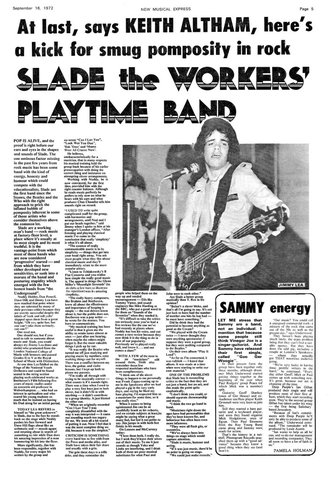
That skinhead image I prefabricated did get them press attention because Disc, NME and the Daily Express all ran pieces and photos of them for the first time. Slade may have been getting noticed for all the wrong reasons but we stuck a boot in the media's door. Now all they needed was a hit record.
The number that always got the fans going at gigs was their final song, a version of the old Little Richard record 'Get Down And Get With It.' Chas encouraged them to record it as though it were live to capture the excitement they were generating at clubs. He took them to the big studio at Olympic in Barnes for the first time. They felt at home in a space the size of an aircraft hanger and re-created a live performance. Nod sang with the group in the studio and they added the boot stomping later themselves by overdubbing until they sounded like a regiment of the Guards tromping through the studio.
"The other breakthrough was in the way we recorded Nod's voice," says Jim. "I was talking to the studio engineer about the big voice Lennon was getting on record and he said, 'Oh, you mean ADT' which stood for Automatic Double Track, and we did that with Nod's voice and it sounded fantastic. He had a big voice anyway but this made him sound colossal."
"Chas always mixed my vocals right up front," says Nod. "It used to piss the others off at times but then his justification was: 'lf yoos have a greet song, yoos want people to hear the words, don't yoos?'
Nod remembers that although by this time they'd discarded the controversial skinhead look and re-grown their hair, there were a few street elements that he held onto and adapted.
"I kept the trousers at ankle length, and so did the others, and the braces, but added a huge flat cap and later really lurid jackets," says Nod. "It gave me a matey, macho stance that older media people thought of as music hall, so they no longer felt threatened. And then Dave fell in love with glam rock and went to shop for stage clothes on the planet Zod."
There was a minor hiccup with 'Get Down And Get with It' when the band dutifully began paying over the publishing royalties to Little Richard. It said R. Penniman (his real name) on the composing credits but the song was actually written by Bobby Marchan and he was not happy.
"I've got a copy of his original record somewhere, which was not a hit, and neither was Little Richard's version," says Nod. "I'm not sure 'Little' ever forked out his royalties to Marchan, but we did."
After the success of ' Get Down .. .' the next challenge was to follow it and Chas kept on at them to write something themselves.
"Why don't yoos lads write aboot six?" said Chas to Jim.
"You want me to write about tea time?" queried a puzzled Jim.
"No," said Chas, exasperatedly trying to moderate his thick Geordie accent. "I mean like women. Y'know, the opposite six, mon?"
"Chas originally decided to pair Jim and me off because he hadn't tried the combination before," says Nod. "We seemed to suit each other because Jim liked to come with an idea worked out and I would sing my way into what he'd written. Then I would come back with my lyric and feel and he would hear my vocal with his melody for the first time. Sometimes he liked it and sometimes he didn't."
"My first take in the studio would usually be the best because that was when it came straight from the heart. It was the method I had heard that Elvis and Little Richard used to record their million-selling hits. It was nearly always my first or second takes that were used on the finished record."
The band would get their chance to contribute in the studio later, plus Chas would become involved as producer, which usually meant Jim would have to remove a keyboard or an organ.
"I think keyboard is a terrible idea, Jim," Chas would say. "It always reminds me of Pricey (former Animals organ player Alan Price) when he ran off and left The Animals in the lurch." Dave would usually agree because he thought anything with keyboard, no matter how appropriate, resulted in less success. The beautiful 'How Does It Feel' only made number 20.
"Piano equals failure," muttered Dave to one side.
Nod and Jim both nurtured a healthy respect for jazz virtuosos Django Reinhardt and Stephane Grappelli, whose works they tuned up to back stage as a jam. Jim can recall doing this in the their room at a charity concert at Wembley in the early Seventies when suddenly the now dearly departed comedian Spike Milligan appeared and just sat down to listen. The boys stopped and smiled politely and asked if there was anything they could do for him.
"No, I heard what you were doing and just came to listen. You're great I can't wait for you to go on," said Spike. What the loveable old comic, who was jazz fan, thought of their thunderous on stage performance later is not on record. Slade's own tribute to these two influential jazzers was the B-side 'Kill 'Em' At The Hot Club Tonite', the Hot Club being the venue that Stephane and Django made famous in Paris.
Jim also used a Grappelli-style violin break on 'Coz I Luv You' which he adapted at home in Wolverhampton, where his dad complained about "the horrible noise" and Jim patiently explained he was writing a "sixy" song for Chas, before taking it round to Nod's house to work on.
"I actually wrote 'Cos I Luv You' in about 20 minutes on the basis of what Jim had already put down," says Nod. "We weren't convinced it was us because it sounded like a pop song at first, but in the studio we 'Sladeified' it."
When they played Chas their acoustic version of "Coz I Luv You" he listened intently, paused and then proclaimed in his usual emphatic Geordie tones: "Yoos have just written yers first number one."
Jim and Nod thought he was mad, seeing as it was then quite a gently paced love song and not what was expected from Slade as a follow up to 'Get Down .. .'. However, Chas recognised the ingredients of a great big beat ballad and things changed in the studio when original title 'Because I Love You' became 'Coz I Luv You' and the group stamped their own musical personality all over the song.
Chas picked up on "bog wall easy speek" for the record titles in the same way as he had once adapted a certain Jimmy Hendricks to Jimi Hendrix, establishing the "skool's out alphabet." He knew if there was one thing that put kids on your side it was the ridiculing of a persistent adult moan, such as their children's poor spelling, plus Nod agreed because he'd seen the writing on the walls in Wolverhampton toilets and it looked and sounded the way they spoke "bak 'ome."
"When we first recorded 'Cos I LuvYou' I was completely dissatisfied with the way we interpreted it," says Jim. "It came out sounding too sugary for me. Now I feel it was one of the most complete songs we ever recorded because it was the simplest."
Chas was at his best field-marshalling the marketing strategy with the record company and using his Beatles' formula blueprint. If the Fabs could go straight to number one then his boys could as well. Chas pre-plugged on the radio, gave prior notice to the fan club and set up a pre-demand strategy that would be copied and refined with every single from then on to create huge advance orders and send Slade singles catapulting straight into the number one slot.
Once Slade hit the top with 'Coz I Luv You' they were on a roll and the follow-up, 'Look Wot You Dun,' made a very respectable number four in the charts. "We were unsure about it," recalls Nod. "We thought it might be a bit too keyboards based and it was not in our stomp and roll style, which suited the stage, but it did have a Beatles feel, which Chas liked."
"Piano equals failure," grumbled "The Glittering One" from a dressing room corner when 'Look Wot You Dun' became a comparative flop by not hitting number one like its predecessor.
The next single 'Tak' Me Bak 'Ome' was right up the fan's alley and tailor made for the stage. It was a red hot number one. The lyric was inspired by their image as home-loving boys who genuinely looked forward to going back to Wolverhampton. Slade never felt comfortable with the swinging London set, which their manager was keen for them to infiltrate. Slade were, as Nod often said, "no good at pretending to be cool."
On the back of the success of' Tak' Me Bak 'Ome' I wrote a double page spread in the NME, "At Home with Slade in Wolverhampton," and toured their local haunts in Nod's new Avenger car, such as their favourite watering hole, the infamous Trumpet pub-club, where they introduced me to local musicians Tommy Burton and pianist Reg Keirle, whose rendition of, 'My Rhubarb Refuses to Rise' still brings a tear to my eye some thirty years later.
We drove through the stark areas of Wednesbury and Tipton, which Noddy referred to as "Wolverhampton's Sunset Strip". These were the places that gave the band their down to earth identity and roots, where they were comfortable with their families and friends. Nod pointed out Pipers Row, where the scarlet ladies stalked looking for clients, and the butcher's shop where Mick Marson, whom Nod replaced in The 'N Betweens, used to work.
We wound up at the local church where the man they affectionately called "Holy Joe", alias the Prebendary Philip Husban, aka ''The Preb," gave shelter and rehearsal room to aspiring local bands like The Invaders, Breadhead and the then relatively unknown Judas Priest. He addressed them alike with a cheerful, "Still making that hideous row," and a cry of "Fares please," when he came to collect the few shillings he charged for the use of the church assembly rooms.
I often wonder what Holy Joe would have made of Noddy's subsequent famous entrances on stage in a dog collar, doing his version of the marriage ceremony for Slade fans: "Dearly beloved we are here tonight to join this rock to this roll ..... I think he would have loved it. He was that rare kind of good-hearted clergyman, who believed Jesus must have had a good laugh sometimes and working with youth was an investment in the future.
Slade records were seldom in the hippie's record collection, but it was amazing what happened when they played to "the unconverted" new audiences at Festivals like Lincoln, Reading and Donnington, which after a few blistering numbers became the scenes of famous victories for them in the face of adversity.
Around the time of Take Me Bak 'Ome: at the end of May, 1972, Slade agreed to risk appearing at Lincoln as part of the Great Western Festival. Jim travelled there in a car with Chas and confessed that he was nervous about being on a bill with heavyweight groups like The Beach Boys, Genesis and new critical darlings Roxy Music - it was an underground audience and Slade were seen as a pop band. Chas was his usual bullish self and told him firmly: "Trust me - yoos lads are gooing to write a new chapter in the annals of rock and roool today." And they did.
"We went on to a chorus of boos and jeers, but got across that we just wanted to help them have a good time, and after three numbers there were sixty thousand all on their feet cheering." remembers Nod. The weather improved. The Sun came out. The rain stopped and the crowd got up and clapped. It was divine "interference."
It was also an element of unholy intervention from Chas. He delayed everything back stage until it was right for his boys to go on in the twilight. You can also factor in Slade's indefatigable ability to stand and deliver the goods, but whatever it was it worked.
"Even the music press had to admit we won that battle and I put some icing on the cake by introducing the late actor Stanley Baker, who was one of the promoters, on stage. I got the crowd to chant, 'Stanley, Stanley, Stanley: like the native warriors in his most famous movie, 'Zulu: He came up, took a bow to the chanting and loved it."
Lincoln was an important break for Slade because it proved that, though they might have been branded a top pop group by the teen press, they had genuine rock credentials when it came to live performance. This was confirmed that week by the Melody Maker, who printed a full page photo of Nod in his bowler hat with his 'The Pope Smokes Dope" slogan slapped on the brim, looking like one of the droogs from 'A Clockwork Orange: The crowd were pictured on their feet, clapping over their heads in obvious enjoyment. Slade had proved to the sceptical music critics that they really rocked.
"We'd been told at Lincoln before we went on that no one was allowed to do an encore," adds Nod. "But the reaction was so good Stanley told us we must go back out and do another number, so we did and I just yelled something at them like, 'Is everybody crazy now?' and we had an idea for another single."
Jim also remembers that the buzz word "crazy" stuck in his mind from something the bouncers said to them at a gig with the Walker Brothers. When they asked how the three Americans had gone down, the bouncers told them:
"They were all crazy on whisky."
When they wrote the original lyric it was, "My, my, we are all crazy now," but Nod sang it "Ma Ma" and after Chas heard it live he was convinced it was "Mama" and so it became "Mama Weer All Crazee Now". The introductory scream Nod gives on the record was meant just to be a warm up, but Chas loved spontaneity and kept it in. Jim still believes this was the finest rock song they ever wrote, although afterwards of course the pressure was on to write more hits quickly and consolidate.
Slade were now also finding themselves in huge demand for live gigs but they felt honour bound to fulfil their contracts with those small clubs who gave them the work when they needed it.
"The little clubs were heaving at the seams now with the extra demand for tickets," says Nod. "I can recall one scene at the Belfry in Birmingham where it only took a few hundred people but they were queuing for three miles down the road. It was the same at all the little clubs we still had to play."
America was "the great challenge that proved impossible to crack for the boys from The Black Country. They were never understood or promoted successfully by the Americans 'and Chas made an initial error by trying to go in "big time" to New York without a hit single.
"The problem was that we were not big time in America, nor did we know how to behave like it," grins Nod. "There was an absolute classic at the airport when we arrived to a no-show reception and quietly picked our own luggage up off the carousel and then climbed into a van we thought had been provided by the record company to take us to the hotel.
"We must have looked impressive on arrival - 'look here come the new Beatles in a renat-a-van: "Apparently there were two long black luxury stretch limos parked directly behind the van, which we ignored because we never dreamed they would be for us. The roadies really appreciated them when they came out later. You can take the lads out of Wolverhampton but you can't take Wolverhampton out of the lads.
"We were just the same at press receptions and big occasions. By the time the media and the VIPs had arrived we'd noshed the free food and drunk the bar dry and we were always the last to leave after everyone else had gone home. We just had no idea of being fashionably late or cool."
Eventually Slade established a reputation in the U.S. the hard way; by live performance in New York and big cities like Detroit and Cleveland. But on the West Coast and in the South they couldn't make a dent. The media just didn't know what to make of them. Slade were too heavy for AM stations, but did get play on FM, which was how they were able to sell out 20,000 seat stadiums in some cities. The American press, however, took one look at their image, raised an eyebrow, and confirmed that vaudeville was dead. On top of all this they couldn't understand a word of their heavy midlands accents, but Chas was determined that Slade would eventually break and that they would not become, as Jim now feared, "just a cult band."
"Yoos don't want to throw in the sponge now, do yoos Jim? Yoos know what a cult band is, don't yoos Jim?" Chas reprimanded Slade's bass player firmly. "It's a band with no hits followed around by a few pseudo musical morons."
One plus that did emerge from an early American trip was the song 'Gudbuy T' Jane; which Nod reveals was inspired by a girl they met on a TV programme. Jim got the idea for the melody and the verse and when they got to the studio Nod went to the 100 for inspiration and came out with a new lyric. He wanted it to sound more optimistic, to sing "'Ullo to Jane." But Jim. ever the pessimist, stuck to his guns and it was gudbuy to that and "Gudbuy T' Jane."
"Jane was the co-host of a San Francisco pop show we appeared on, who was there as eye candy;' says Nod.
"She just draped herself over the host but never spoke on screen. She threw a fit the time we went on because she'd lost one of what she called her 'Forties Trip Shoes: These were the fashionable high platforms already in Bibas in London, but the U.S. were still catching up. She was determined not to appear with only one shoe and was hysterical. That is what the song is about."
The hits were now flowing from the pens of messrs Lea and Holder. Their next single, 'Cum On Feel the Noize; went straight to number one from nowhere. The idea for the
follow up:Skweeze Me Pleeze Me: came from an audience participation number; which they saw Reg Keirle, their favourite pianist, do at The Trumpet in Wolverhampton.
"That went straight to number one, too." says Jim. But, ever the perfectionist, he adds:
"It really was almost too easy for us now, so we'd throw in something different like 'My Friend Stan: which I never thought was a single, but Chas heard echoes of The Beatles again. It just failed to make number one.
"Piano equals failure." droned a small, irritating voice from the corner of the dressing room.
Slade now had an unprecedented reputation for showmanship and performance allied with an uncanny knack of producing number one records. Nothing less than a chart phenomenon, they were just as popular on stage in the UK, Europe and Australia,
"I think showmanship was second nature to us and we just built our stage act from bits and pieces over the years." offers Nod. "I always tried to involve our audience from a very early stage. Kids just love to join in and feel a part of what's going on. There were always nutters who followed us around, like the girl who dressed as a ballerina who we'd get on stage and sing to. And then there was this local lad, Melvyn, who liked to get up on stage and sing 'Skippy The Kangaroo; which we allowed him to do, and then hopped around behind him when he wasn't looking."
In July 1973, Slade took their audience participation party to the massive 18,000 seat Earls Court Exhibition Centre and the crowd were a mass of top hats and glitter, intending to join in the show. It was a monumental night and Slade were hailed by some as The Kings of Glam Rock.
Dave was wielding his "Super- Yob" guitar and threw himself into the fancy dress tub with such enthusiasm that he emerged looking like a giant revolving Christmas cracker, which was enough for the press to establish that these boys were leaders of the glitterati.
"Elton John's outrageous gear doesn't seem to have done his record sales any harm;' Dave justifiably pointed out when he was criticised for going over the top.
Jim later met up with Elton in LA when he was playing giant stadiums and Slade were still struggling to establish themselves in smaller venues on the West Coast.
"Y'know" said Elton candidly, "I just don't get it. You should be the ones playing these giant stadiums - you're made for it. But it's just me and my piano. I just don't get it." Neither presumably did Dave because it was certainly one case where piano equals success.
Glam Rock and their "wacky" image, as Jim refers to it, might have been something of a musical strait jacket were it not for their ability to prove again and again on stage that they were also a great live act. Called in at very short notice to replace Ozy Osbourne, Slade proceeded to steal the show at the 1980 Reading Festival, from which their hit EP charted with the hugely popular 'When I'm Dancing I Ain't Fighting:
The following year they played the heavy metal Donnington Festival in Derbyshire to similar acclaim, emerging with another hit, 'Lock Up Your Daughters:
Massive crowds held no fears for Slade, who could really mix it up with the big boys and loved proving to the critics they could blow most other bands off the stage with their songs.
There are some rare, unsung gems in this collection, which were featured on the B-sides of singles and were unheralded cuts on early albums - like 'One Way Hotel'.
It was written by Don, Nod and Jim about the terrible, cheap little places where they all stayed in one room with two roadies and, on one occasion, six workmen from a building site.
'The Bangin' Man' was thought to be about a roadie, who used to wake them up early, but was actually "Bonking Man;' who woke them up with other noises not unremoved from the aforementioned "six." Another little oddity, 'Knuckle Sandwich Nancy' concerned a Wolverhampton lass who had tattoos (unusual at the time) and liked to fight men.
Nod took lots of ideas for lyrics from newspapers. 'Myzterious Mizster Jones' came from a story about a spy ring.And their first and only big U.S. hit 'Run Runaway' was inspired by another story about a jewel thief, much like the Pink Panther, sunning himself on the run in the South of France: "See the chameleon lying there in the sun - all things to everyone."
Slade always had the potential to come back with a bang and after being absent from the upper reaches of the charts for much of the late Seventies and early Eighties. they did exactly that with the number two UK hit 'My Oh MY: It was Jim's brainchild, a successful attempt to write an arm-waving smash like Rod Stewart's 'Sailing: and it was followed by another top ten smash, 'Run Runaway.'
As their PR again, in the Eighties, I can recall taking a small press party down to a castle in Wales where they were shooting the video for 'Run Runaway: an event which turned into a kind of Monty Pythononesque nightmare. It was "Rabbie Burns Night" in the hotel and some drunken Scot thought it would be fun to turn on the fire alarm every two hours throughout the night and get us all up out of bed in the pouring rain and down the outside fire escapes.
At one surreal moment in the hotel reception at 4am there were a contingent of the Dagenham Girl Pipers, the entire video crew, a giant caber tosser, firemen with yellow oxygen cylinders on their backs, the old DJ and wrestling commentator Kent Walton, all four members of Slade clutching instruments and in various stages of undress, plus the original BBC 'Mastermind' host Magnus Magnusson who was, unluckily for him, staying in the same hotel.
On the third occasion this happened uniformed police joined the melee because one of Slade's roadies, suffering from sleep deprivation, had a shotgun under his dressing gown and was looking for any Scotsman he could find. The police exited with the road manager, under arrest and apparently grateful for a quiet night in the cells, and Magnus followed them through the hotel doors, his pyjamas flapping about under his jacket, cases packed, muttering darkly: "It happened last night as well."
America adored the 'Run Runaway' video that resulted from this mayhem and was mostly shot in a violent storm - "thunder and lightning very very frightening" as a soaked Dave Hill "Queenly" observed high up on the battlements, whirling about like a dervish in the rain with his guitar a potential lightning conductor.
Nevertheless, it seemed that even with 'Run Runaway' becoming their first ever top twenty hit in America in early 1984, Slade were cursed in the U.S. Things didn't bode well when they arrived for their last tour (they were to be special guests of Ozy Osbourne) at the airport in Chicago to find no car to meet them in the sleet and snow. They had to flag down cabs for both themselves and their equipment and later a record company representative phoned the hotel to enquire whether they liked the flowers and champagne in their rooms.
"We would have preferred the courtesy of a car to pick us up in the snow storm at the airport," Jim told him.
Then the curse really struck. After just a handful of dates, Jim went down with hepatitis and nervous exhaustion and had to be flown home. The Cow Palace in San Francisco, their first scheduled show with Ozy after five warm-up gigs of their own, proved to be Slade's last live performance.
"Sometimes I think Nod unfairly shoulders the burden for breaking up Slade," says Jim. "In fact it was all of us who were worn out from 20 years of touring at the time and I'd had it too at that stage. I think I smelled the writing on the wall when we were supporting Ozy in America and we got the waft of pot from the audience, which seemed to require an obligatory 20-minute guitar solo - which was not our style. We'd finished our song before they even lit up their joints. We were not made for those times. Our time was up that was all,"
Nod was exhausted from 20 years on the road and the extra burden of being acting manager after they'd split from Chas shortly after Reading in 1980. His personal life was in tatters and so he effectively served notice on the band in 1984 as far as playing live was concerned and has steadfastly refused to go back on the road ever since.
"It just was not fun any more," he says simply. "I think we quit at the right time to earn the respect and re-evaluation we are now receiving,"
There is much more to Slade than meets the eye and this anthology is the first really comprehensive collection to emphasise the point. The four CDs cover all Slade's hits plus key album tracks, rare B-sides and recordings from early in their 20 year plus life-span. This is the definitive overview of Slade's music, enabling us to appreciate the depth and versatility of a band who justly get nominated every year for a life time achievement award - something which surely someone will soon realise is long overdue.
Let the Gud times roll.